What is Goju Ryu karate?
By Sensei Sam Seigers · 4th Dan Seiwakai Goju Ryu · Founder, Yushukan Karate, Tweed Heads South
Goju Ryu means hard-soft. The traditional Okinawan style Yushukan teaches: close-range power, body conditioning, breath work, and real kata study.
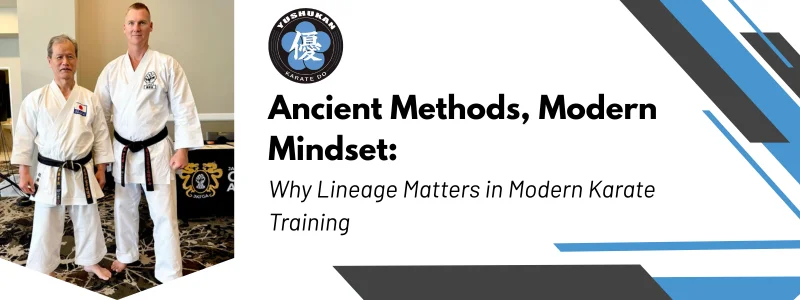
Goju Ryu is one of the main traditional styles of Okinawan karate. The name translates as hard-soft style, and that balance is the whole idea: powerful, direct techniques combined with circular, flowing movement and breath control. It was founded by Chojun Miyagi, who blended the methods he learned in Okinawa and China into a complete system. This article covers where the style came from, what it actually trains, and why it suits people at every stage of life.
Where it came from
Chojun Miyagi was born in Naha, Okinawa in 1888. He trained under Kanryo Higaonna, who had spent years studying in Fujian Province, China, absorbing White Crane and Tiger boxing methods. When Higaonna returned to Okinawa he brought back a system that was already a blend: Chinese influence filtered through Okinawan practicality.
Miyagi continued the process. He made his own trips to China, studied further, and worked to systematise what he had inherited. What he formalised became Goju Ryu, a name he used publicly for the first time in 1930. The result was a coherent system: a warm-up sequence, a set of kata, and a method of partner training that moves from basics through to pressure testing.
What hard-soft actually means
It is easy to treat the name as a slogan. On the mat it has specific meaning. Hard refers to direct, forceful techniques: linear strikes, strong stances, body conditioning, the kind of power built by close-range impact work. Soft refers to circular movement, evasion, redirection, and the breathing that connects it all. Goju Ryu trains both, deliberately and in sequence.
This is clearest in the two foundational kata. Sanchin develops the hard qualities: posture, tension, breath under pressure, structural stability. Tensho develops the soft ones: circular arm movement, breathing, the ability to stay connected and fluid. Neither kata is complete without the other, and neither is understood quickly.
The core curriculum
Goju Ryu has a structured curriculum. Not every school teaches it identically, but the core is consistent across legitimate lines. At Yushukan the curriculum covers four areas.
- Junbi Undo: the traditional warm-up and joint preparation sequence. Fifteen minutes in every adult class. Not a token stretch.
- Kihon: basic techniques practised in isolation and in combination. Punches, blocks, kicks and combinations, built from a rooted stance.
- Kata: twelve recognised kata in the Goju Ryu system, from Gekisai Dai Ichi at the beginning through Suparinpei at the highest level. Kata is studied for application, not performance.
- Kumite: partner work, from controlled basics through to free sparring. Pressure testing what the kata is built to teach.
Close range and practical application
Compared with longer-range styles, Goju Ryu operates at close range. There are kicks in the system, but the emphasis is on punching range and closer, where most real encounters happen. Strong stances, body conditioning, and the ability to absorb as well as deliver are part of the design.
The kata contain applications at that range: deflections, controls, throws, and strikes that make sense when you study them properly. This is one of the reasons kata study is taken seriously in traditional Goju Ryu. They are not performance routines. They are a library of responses encoded in movement, meant to be studied rather than just memorised.
Sanchin and Tensho
These two kata sit at the heart of the system and are unlike anything else in the curriculum. Sanchin is short in shape but demanding in depth: a small number of techniques performed slowly, under tension, with breath control as the core skill being trained. It is the same kata Miyagi learned and refined across his lifetime, and it is still the kata that separates students who understand the system from those who have only learned the surface.
Tensho uses the same breathing frame but with open-hand, circular arm movements. Where Sanchin is controlled tension, Tensho is controlled softness. The combination of both is what makes the system distinct. Detailed treatment of Sanchin is in the what is Sanchin article.
How Goju Ryu differs from other styles
Shotokan is the most widely taught karate style globally. It emphasises linear techniques, long stances and sport competition. Kyokushin emphasises heavy-contact knockdown sparring and conditioning. Goju Ryu sits between them: harder and more practical than sport Shotokan, more rounded and longer-term than Kyokushin. The closest comparison is the other Okinawan styles, Shorin Ryu and Uechi Ryu, which share the same historical roots.
The detailed comparison is on the Goju Ryu vs Shotokan vs Kyokushin page.
Why it suits real people at every stage
Because Goju Ryu trains both hard and soft qualities, and because Junbi Undo prepares the body for training rather than leaving that to training itself, the system scales to the body in front of it. Children build coordination and control. Teens build capability and confidence. Adults build strength and mobility without being pushed through a program designed for twenty-year-olds.
Adults who begin in their 40s or 50s are not unusual at Yushukan. They are expected. The warm-up sequence exists for them. Sanchin was designed for them. The kata system gives them something to study for decades rather than something to finish in three years. That is the payoff of a lifetime art.
Goju Ryu at Yushukan
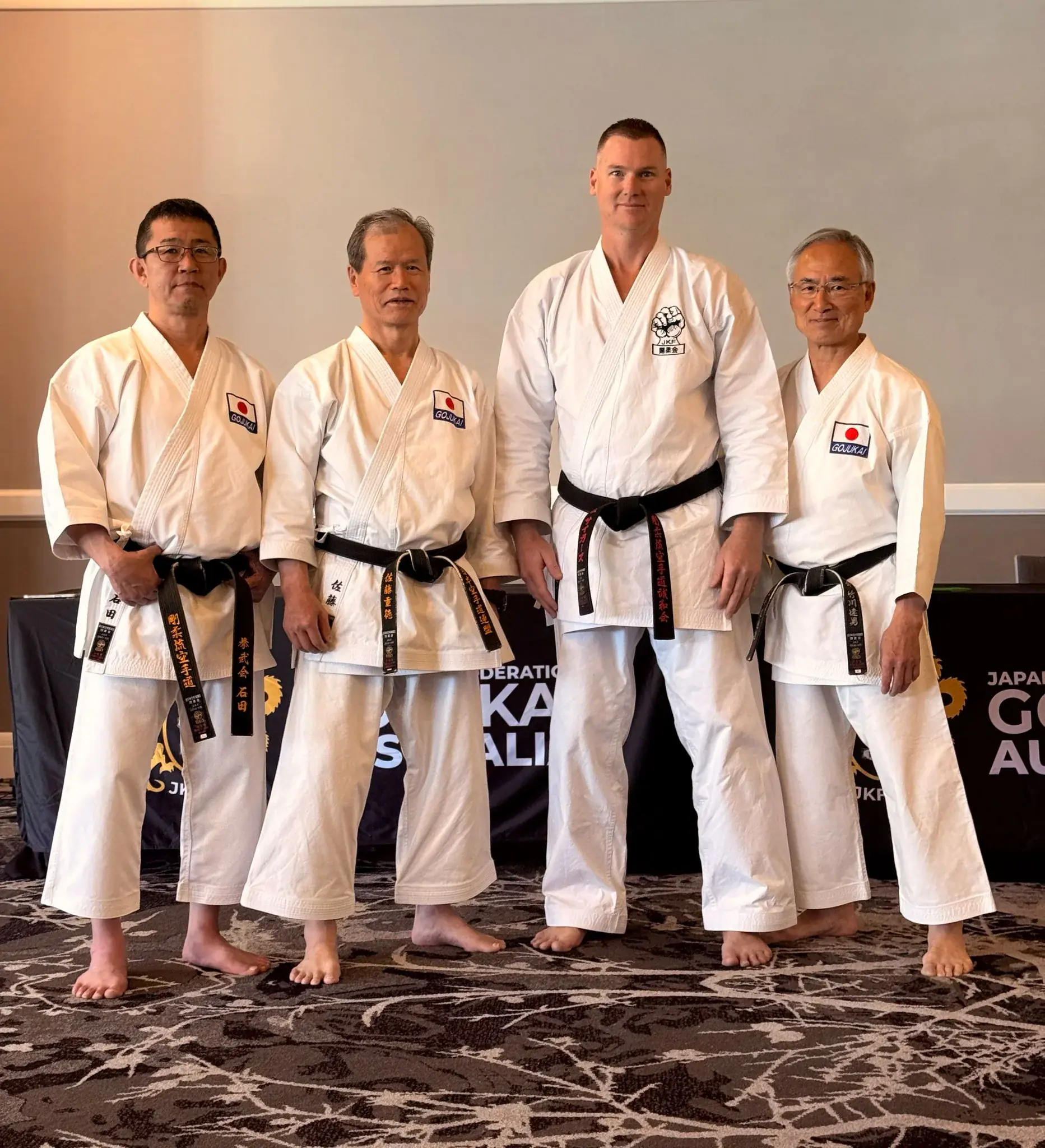
At Yushukan we teach Goju Ryu in its traditional form, to the standard of Gojuryu Seiwakai Karate-Do International and the All Japan Karate Federation Gojukai. Both lines trace through verifiable rank holders back to Chojun Miyagi. Sensei Sam holds 4th Dan through Seiwakai and 3rd Dan through JKF Gojukai, and continues to train under senior instructors in both organisations.
The kata are the real kata. The lineage is verifiable. The standards are ones senior instructors in both organisations would recognise. For those wanting to assess what that means in practice, the how to choose a karate dojo page runs through exactly that.
Quick answers
- What does Goju Ryu mean?
- Hard-soft style. Goju combines Go (hard, direct power) and Ju (soft, circular movement and breath). The name was formalised by founder Chojun Miyagi in 1930.
- How is Goju Ryu different from Shotokan?
- Shotokan emphasises long stances, linear strikes and sport competition. Goju Ryu operates at close range, combines hard and soft qualities, and places much greater emphasis on breath control through Sanchin and Tensho. Goju Ryu is also designed for lifetime practice rather than peak athletic performance.
- Is Goju Ryu good for beginners?
- Yes. The system is designed for gradual, long-term development. At Yushukan, beginners start with Karate Ready, a structured 3-week pathway that introduces the fundamentals without throwing you into a full class on day one.
- What is the highest kata in Goju Ryu?
- Suparinpei, which translates as 108. It is the most advanced kata in the traditional Goju Ryu system and is taught at senior black belt levels. Most practitioners will spend their entire karate lives working on the earlier kata.
- Can adults start Goju Ryu later in life?
- Yes. Goju Ryu is specifically designed for lifetime practice. Adults starting in their 40s or 50s are not unusual at Yushukan. The Junbi Undo warm-up, Sanchin breathing, and kata study are all suited to the adult body and mind.
Written by Sensei Sam Seigers, 4th Dan Seiwakai Goju Ryu and 3rd Dan All Japan Karate Federation Gojukai. Sam founded Yushukan Karate in 2020 at the Tweed Heads South Honbu Dojo (Unit 3/58 Machinery Drive, Tweed Heads South NSW 2486). He continues to travel to Japan and Okinawa to train under Seiichi Fujiwara Hanshi and other senior teachers.
Yushukan Karate teaches traditional Goju Ryu to kids 7+, teens, and adults. Beginners start with Karate Ready, a structured 3-week pathway.