Is karate good for a child with ADHD or anxiety?
By Sensei Sam Seigers · 4th Dan Seiwakai Goju Ryu · Founder, Yushukan Karate, Tweed Heads South
For low-spectrum ADHD and anxiety, often yes. The structure helps because we agree on it openly with parents first. Here is how Yushukan handles it.
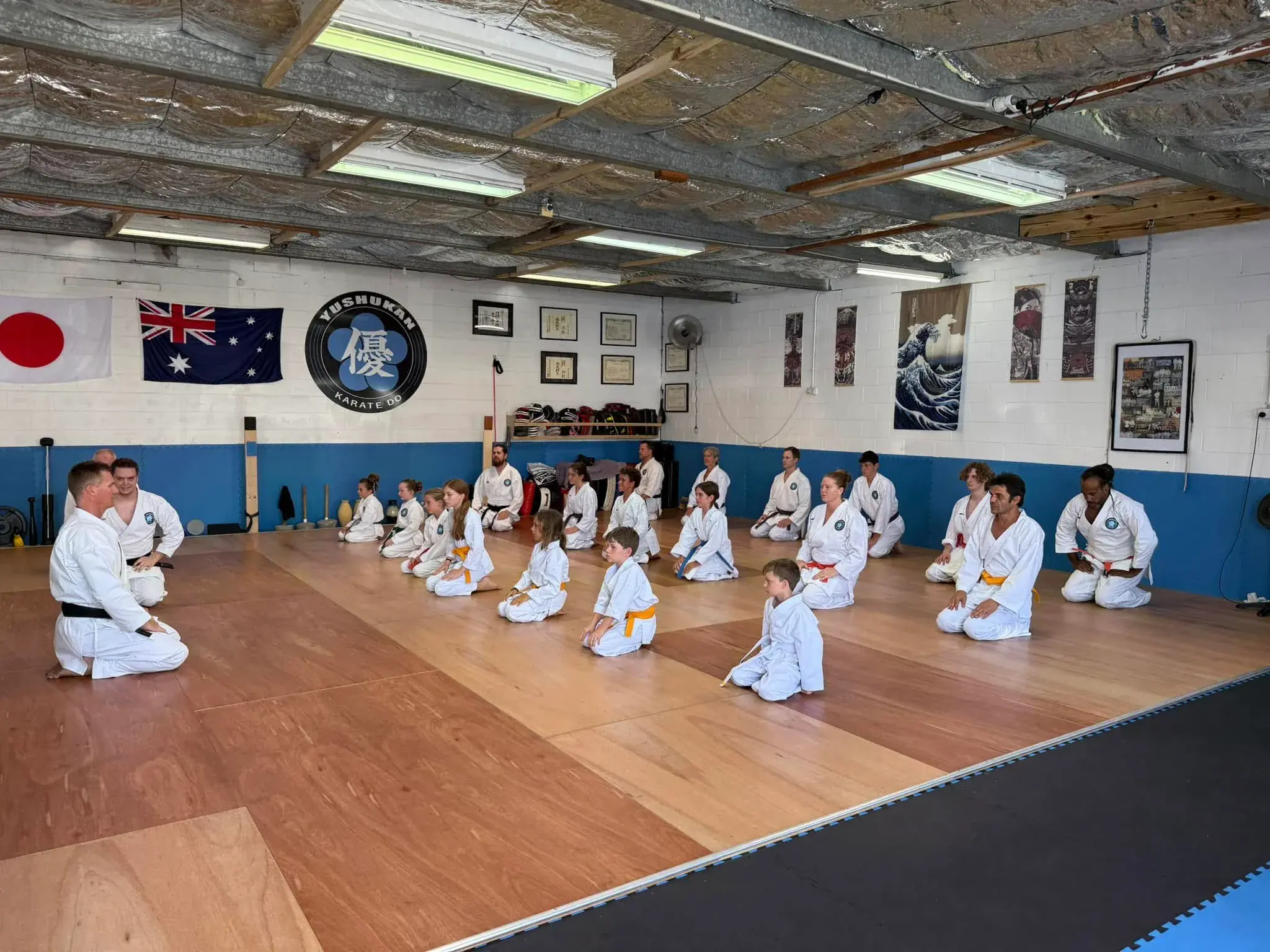
It is a common and fair question, and the honest answer depends on the child. For low-spectrum ADHD and for anxious children, the structure of a traditional dojo often helps in ways that unstructured sport does not. For high-support special needs, we are honest that we do not have the staffing or specialist training to do justice to those students.
Why structure helps with ADHD
A traditional dojo is predictable in a particular way. The class has the same shape every session: bow in, Junbi Undo, basics, partner work, bow out. The rules do not change based on who is having a good day. The instructor corrects the same things in the same way each week. For children who need clear rhythm and clear expectations to settle, that consistency is often the thing that lets them participate without constant redirection.
There is also a body element. Karate is physically demanding and uses the whole body in a way that many children find regulating. The combination of physical output and structured attention demands, listening to instruction, copying a precise movement, waiting for the next command, tends to occupy the nervous system in a productive way for the duration of the class.
This is not a claim that karate fixes ADHD. It does not. What it can do, for the right child, is provide a structured physical environment where the ADHD presentation is less disruptive than in an open-play or team sport setting, and where the child experiences succeeding at a structured task. That experience matters.
Why the dojo works for anxious children
Anxiety in children often comes with a specific difficulty with the unpredictable: the new situation, the unexpected social demand, being called out in front of a group. A traditional dojo removes much of that uncertainty. The format does not change. The instructor does not surprise students. There is no team rotation, no arbitrary grouping, no exposure before the child is ready.
New students at Yushukan are not called out or put on the spot in their first weeks. They follow along, are corrected quietly and individually, and are not expected to perform for the class. The structure of bow-in, warm-up, basics is the same every session, so the child always knows what is coming next.
Partner work is introduced gradually and always supervised. For a child who finds unexpected physical contact difficult, we introduce partner drills carefully and match them with an appropriate partner. That is a conversation we have with parents before the first session, not something we handle by surprise.
The conversation we have before the first session
For any child with ADHD or anxiety, we ask parents to contact us before the first session, not on arrival. We ask three things. What does the child find difficult in structured settings? What does success look like for them and for you? And what would we need to know to give them a good first session?
With that information, the instructor can prepare. Not in a clinical sense, but in the practical sense of knowing that a particular child needs to stand on the end of the line rather than the middle, or needs a brief one-on-one explanation before class begins rather than during it, or needs a settled two minutes before the rest of the group arrives.
For ADHD specifically, we agree, with parental permission, that the instructor can redirect the child directly and respectfully for the benefit of the class. That agreement is important. It means the child, the parents and the instructor are aligned on what respectful redirection looks like, rather than anyone being surprised by it.
ADHD and anxiety are not the same
They often coexist, but the experience in the dojo is slightly different for each. A child with ADHD typically benefits from the structure and physical engagement. A child with anxiety typically benefits from the predictability and gradual exposure. A child with both needs careful attention to the rhythm of the class and a clear communication channel with parents.
Neither condition rules out training. What matters is the match: the specific child, the specific dojo, and whether the instructor is the right fit. The 3-week Karate Ready pathway exists partly for exactly this reason. Three weeks gives enough information for an honest decision in a way that a single class never can.
What parents should ask any dojo
Not every martial arts school approaches this the same way. Before committing to any dojo, ask these questions.
- Have you taught children with ADHD or anxiety before? What did that look like in practice?
- Can I talk with the instructor directly, before the first session, to discuss my child specifically?
- What happens when a child cannot focus during class? How is redirection handled?
- How are new students introduced to partner work?
- What is your class size, and how many instructors are on the mat at once?
A school that answers these questions specifically is worth visiting. A school that says "we are great with all kids" without being able to say how is not.
Where we are honest about our limits
For high-support special needs, for children with severe sensory sensitivities, or for children who need a one-on-one aide to participate in any group setting, we will tell you plainly that we are not the right environment. We do not have the staffing or the specialist training to do it properly. A good outcome for a child in that situation requires a specialist program, and sending them to a general dojo is not that.
That honesty is the same standard we hold for everything else at Yushukan. We would rather direct a family to the right support than provide a poor version of it.
How to start
Contact us before booking. Use the enquiry form or call directly. Tell us about the child: age, what they find difficult, and what has worked or not worked in other structured settings. We will tell you honestly whether we think the fit is right, and if it is, we will prepare the first session accordingly.
The 3-week Karate Ready pathway is the right starting point. The Week 4 readiness check is built into the structure so that both sides, the dojo and the family, get honest information before committing to a term. That is always a better outcome than a single class that proves nothing and a term that turns out to be the wrong fit.
Quick answers
- Is karate good for a child with ADHD?
- For low-spectrum ADHD, often yes. The predictable structure, physical engagement and clear instructions can help children with ADHD settle and participate. We have a short conversation with parents before the first session to prepare the right conditions. For high-support needs, we are honest that we are not the specialist environment for that.
- Is karate good for anxious children?
- For many anxious children, yes. The format is consistent: bow-in, warm-up, basics, bow-out. New students are not called out or surprised. Partner work is introduced gradually. We ask parents to tell us before the first session so we can prepare a calm start.
- What age can a child with ADHD start karate?
- At Yushukan, children start from age 7. The minimum age is not based on ADHD or anxiety status. A 7-year-old with ADHD can train here if the specific fit is right. Contact us before booking so we can assess that together.
- Do you have specialist training for special needs?
- No. We are a traditional karate dojo. We can accommodate children with low-spectrum ADHD or anxiety in a general class setting with appropriate preparation. For high-support special needs, a specialist program is a better fit than a general dojo.
- Should I tell the instructor about my child's ADHD or anxiety before the first class?
- Yes, always. Telling us in advance means we can prepare the first session properly. Telling us on the day limits what we can do. Use the enquiry form or call before you book.
Written by Sensei Sam Seigers, 4th Dan Seiwakai Goju Ryu and 3rd Dan All Japan Karate Federation Gojukai. Sam founded Yushukan Karate in 2020 at the Tweed Heads South Honbu Dojo (Unit 3/58 Machinery Drive, Tweed Heads South NSW 2486). He continues to travel to Japan and Okinawa to train under Seiichi Fujiwara Hanshi and other senior teachers.
Yushukan Karate teaches traditional Goju Ryu to kids 7+, teens, and adults. Beginners start with Karate Ready, a structured 3-week pathway.